


These are the “Lost Updates” from KansasFest 2009 that I had planned to post each evening during the event. I apologize for not posting them in a more timely fashion. The only excuse I have is that my professional responsibilities unexpectedly required immediate attention and had to take precedence over my hobby for the last few weeks. I’m sorry if anyone was disappointed. Next year, I plan to spread the reporting duties around, if possible, so that this sort of thing doesn’t happen again.
Morning came earlier than expected as it always does during late-night Apple II projects. I was up until about 2:00 am, unsuccessfully trying to get my Dell Mini 9 Hackintosh to talk to my Apple //c via serial cable. As it turned out, I didn’t have the correct driver for not one, but two different USB-to-serial adapters I had brought along. I suppose I assumed they would just work, as most things usually do when I plug them into a Mac. No worries I thought, I’ll just download the drivers… and that’s when frustration began to set in. I went to the site where I had purchased the first adapter, only to find they didn’t sell THAT particular adapter anymore. The driver for this rather plain looking, “made somewhere in Asia” device wasn’t anywhere to be found. I then tried generic-looking adapter #2… no joy there either. I then scoured the Intertubes grabbing various reference drivers to try but I failed to get any of them to work. By then I was tired and full of fail, so I decided to put this project off until later. Who knew my RetroChallenge would start out so… challenging.
I found out this morning that a new point upgrade to Virtual II for OS X was released (version 6.2) a few days ago and it snuck right past me. I really like this emulator and try to get the word out whenever Gerard Putter releases something new. Gerard, if you’re reading this, can you drop us a line in the future?
What’s new in Virtual II version 6.2
- Added power management options to save energy and enhance battery life on a notebook Mac.
- Fixed an issue that caused the game disk “World Karate Championship” to fail while booting.
- The Help menu now contains an item to open an online version of the Help section in a web browser.
- In the Inspector, fixed an issue where two lines in the disassembly could be highlighted at the same time.
- Resuming an original Apple ][ from a saved state file could result in incorrect video settings. This has been solved.
- Clarified some topics in the Help section: printing with a limited license, and joystick emulation with the keyboard.
OK, time for sessions. I don’t have time to hit the cafeteria for breakfast so it’s a bottle of water, a few granola bars and we’re off.
Ryan Suenaga presented an informative session on Geocaching, a recreational activity where items of (hopefully) interest are left at specific coordinates to be found by others using GPS devices. As an exercise, Ryan encouraged attendees to find a new power inverter kit he had hidden nearby. Tony Diaz quickly claimed the prize, when he went looking for it before the session had even finished.
Up next, new attendee Ivan Drucker espoused the virtues of the often forgotten, under-appreciated Apple IIe Card for Macintosh LC. Ivan did a good job advocating for the IIe Card, and handily demonstrated it’s finer (and occasionally lesser) points. Overall, there was a lot of interest in this session and a few of the attendees expressed a desire to acquire one soon. I’ve noted that prices on eBay for these cards fluctuate all over the place. I’ve seen new, sealed cards go for $20 to $100 or more, so shop around if you want one. They not exactly rare.
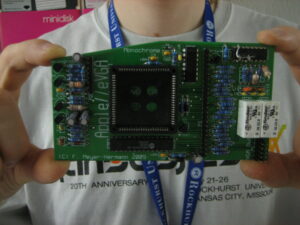
After lunch, new attendee Ferdinand Meyer-Hermann of Frankfurt Germany presented a highly technical overview (nearly a thesis actually) of the immense technical challenges involved in creating a VGA converter for the Apple II. That was interesting, but even better, Anthony Martino announced the availability of new products developed by Ferdinand, that will be sold through UltimateApple2. Anthony’s press release follows:
The Apple II VGA will be for sale only at KFEST. The //c version is $135 (uses the //c video expansion port), and the //e version is $100 (requires Applied Engineering Ramworks card). The boards are second revision, working prototypes. After a re-layout, a final product will be released for sale to the Apple II Community.
Known issues with prototypes for sale at KFEST:
80 column text on some LCD Monitors isn’t as sharp as it could be. This will be resolved in the final relased product.
Video mode reset doesn’t always reset correctly, which could cause some video to appear differently than normal.

Wow, this is big deal. Getting crisp, accurate Apple II video output on a VGA monitor has been a pipe dream for a long time. Anthony set me up with samples of each adapter, so I could try them out. Thanks Anthony!

Ken Gagne next played a montage of Steve Wozniak’s recent appearances on Dancing With the Stars. We like Woz as much as we like the Apple II because he’s a genuinely nice person. Of course it was a visual disaster but Woz really enjoyed himself and you had to feel happy for him because dancing with Karina Smirnoff would make any guy happy.
It was time to get technical again, as Eric Shepherd instructed us on a Apple IIGS Toolbox basics. The hour and a half that was allocated wasn’t nearly long enough to scratch the surface of this topic but Sheppy did his best to cram what he could in the time he had.
Eric also used his time to announce that Sweet16 2.0 was finally out of beta. Edit: Sweet16 2.1, and 2.1.1 (bug fixes) have subsequently been released. Sheppy’s announcement follows:
Sweet16 2.0, the latest version of the Apple IIgs emulator for Mac OS X, is now available! The major improvements in Sweet16 2.0 are:
- Networking support using the Marinetti TCP/IP stack.
- 16-bit color graphics, rendered using OpenGL.
- Added Emupack support; Emupacks are self-contained packages containing disk images, ROM, and preferences that you can double-click in the Mac OS X Finder to start up an Apple IIgs configured in a specific way.
- Resizable video window.
- A handy, scriptable Debugger to make developing Apple IIgs software easier than ever.
- Full-screen support.
- Joystick and gamepad support.
- You can now copy text between the Mac and Apple IIgs clipboards using NDAs provided with Sweet16.
- CD-ROM media can now be mounted in the emulated Apple IIgs.
- An Apple IIgs desk accessory for switching between full-screen and windowed mode.
- The video window’s title changes to show you the name of the Apple IIgs application you’re currently using.
- A new preference lets you mount 800K disk images on the SmartPort instead of as IWM devices.
- Added a preference to automatically slow to 1 MHz when booting from 5.25†disk images.
- Improved showing and hiding of the Mac mouse cursor.
- Unpartitioned ISO images can now be mounted in the emulated IIgs.
- Disk image format detection is much better.
- The EMUBYTE I/O location now correctly identifies Sweet16 and version 2.0 again.
- The mouse scroll wheel now sends up and down arrow keys to the emulated Apple IIgs.
- If you’re currently at the “It is now safe to shut off your Apple IIgs†screen, quitting Sweet16 no longer asks for permission; it just quits.
- Apple IIgs code can read and write the 640×400 pixel, 16-bit graphics buffer in banks $E2 through $E9.
- Fixed a number of bugs.
Sweet16 2.1 Release Notes
- Added the new View menu and its options for half, normal, and double sizes.
- Moved the Full Screen option to the View menu.
- Fixed a serious GS memory trashing bug in the included “Get Clipboard from Mac” NDA.
Sweet16 2.1.1 Release Notes
- Reworded the alert that appears when trying to mount a CD-ROM when no CD-ROM is found, since the same alert is used both when there is no CD-ROM media available as well as when there is no CD-ROM drive available.
- Memory no longer gets leaked when controls in the Create Disk Image and Create Emupack file panels are clicked on.
- The Create Disk Image panel now lets you create DiskCopy 4.2 images at 1.4 MB.
- The Create Disk Image panel’s size popup no longer wanders out of view when you resize the panel.
- Enabled some new optimizations that noticeably improves performance on PowerPC systems.
- Removed some unnecessary debug output.
- The SpiderMonkey JavaScript runtime is now weak-linked, so that Sweet16 really does now run on PowerPC G3 systems (albeit without debugger support).
- The Create Disk Image panel now lets you choose a disk image format on Mac OS X 10.4; previously this popup window didn’t do anything prior to Mac OS X 10.5.
- Creating disk images of even 1 MB sizes (5 MB, 10 MB, 32 MB, 100 MB, for example) now goes much, much faster, since instead of writing out 512 bytes at a time, these are written 1 MB at a time. A future update will provide a similar performance improvement for floppy size image creation.
- Clicks in the video window are no longer ignored when the System Information window is open.
- Removed some unnecessary mutual exclusion code in the networking support, speeding up networking substantially.
- Rewrote the video timing code to be more precise.
- The main event loop now does sleeps instead of busy-loops, dramatically reducing wasted CPU cycles; Sweet16 plays much more nicely with other running processes now.
After dinner, more programing fun as Ryan Suenaga showed attendees how relatively easy it is to write Marinetti-aware programs that can interact with Internet services like Twitter and Yahoo. These services have published APIs that are well within the reach of an Internet-capable Apple IIGS. Of course performance may be a problem due to RAM or Accelerator constraints …but who would have imagined the Apple IIGS would be doing these things over 20 years after is was introduced? Dedicated Apple II developers continue to push the platform to new heights.
Edit: Ryan has released a couple of useful and interesting CDA and NDA programs which you can download from his site. Check out the other articles too, as Ryan shows examples of how to program Marinetti-aware code in ORCA/Pascal. Remember IIter, the NDA Twitter client demonstrated last year? It’s finally released, and then there is Stock Quote CDA 1.0 and an early alpha release of IPDataReporter CDA.
Our last session for the day was presented by hardware hacker and extreme wall climber, Paul Zaleski. Paul demonstrated firsthand how easy it is to upgrade the Mac Mini on the cheap.
So far, this KFest is off to a great start. It’s time to wander around and see what everyone is up to. Later I might take up my RetroChallenge project again… after we nom, nom, nom on some Krispie Kreme donuts. Thanks for the snack Ryan!